Structural Drying in Atkinson, NH
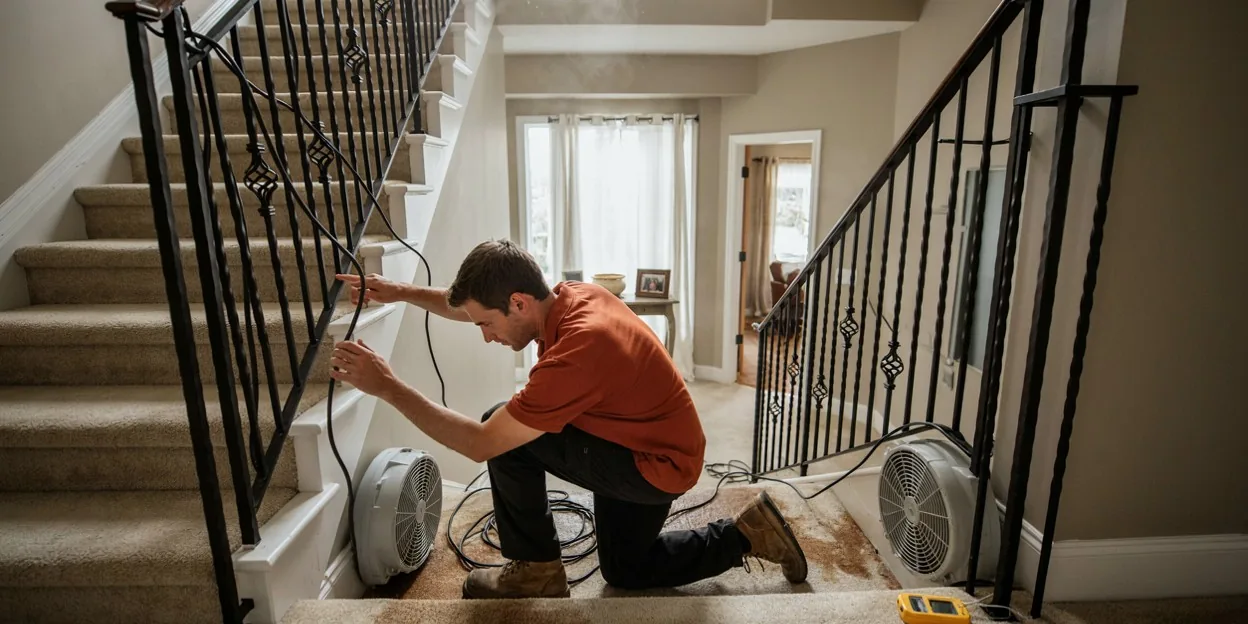
The plumber fixed the pipe on Saturday. You ran fans all weekend and the floor looks fine. On Wednesday the baseboard in the hallway has swollen, the paint on the wall above it is bubbling, and the basement smells like a wet towel. We connect you by phone with an independent local provider who does structural drying in Atkinson and across Rockingham County.
Mapping the wet walls with a meter and a thermal camera
The crew meters the rooms before anything is set up. Drywall, plaster, subfloor, sill plates, and the studs inside a finished basement wall all hold water at different rates, and none of them can be judged by touch. A pin meter tells the crew what is wet. A thermal camera shows where the cold, damp patches are behind the paint. Together they map the loss.
Then the equipment goes where the readings say. Air movers push dry air across wet surfaces so the moisture leaves the material. Dehumidifiers pull that moisture out of the air so it does not settle somewhere else in a closed house. In a New Hampshire basement in April, with 50-degree walls and no dry air outside to help, the dehumidifier does most of the work.
Get the water out and leave the windows shut
Get the standing water out if it is still there. Move furniture off wet floors or put foil under the legs. Pull up area rugs and get them outside. Open cabinet doors and closet doors so air can move.
Do not run the furnace fan or the central air to try to dry the house, and do not open the windows in spring, when the outside air is often wetter than the inside. Take photos of the swollen trim and the stains. Then make the call.
Drywall, cellulose, and sill plates: what dries and what is pulled
Framing, subfloor, and sill plates nearly always dry in place when the crew gets to them within a few days. Plaster on the old farmhouses dries slowly but usually stays. Drywall that wicked water a few inches often dries in place, and drywall that sat in water usually comes out along the bottom so the cavity and the insulation can be dealt with.
Fiberglass insulation that got wet in an outside wall usually comes out. Blown cellulose that got wet always does. Wet carpet pad on a slab goes. Oak flooring can often be dried with floor mats, and the crew meters it before deciding. See hardwood floor drying. Ask the crew what reading supports each removal and how progress will be checked.
Drying a 1990s finished basement and a 1790s fieldstone cellar
The housing around Atkinson was built in two eras that dry differently. The 1970s through 2000s colonials and capes have drywall over fiberglass in the walls and a finished basement with a stud wall an inch off the foundation. Water that gets behind that wall cannot be seen and cannot leave on its own. The crew either drills small holes at the base to dry the cavity or pulls the bottom two feet of drywall.
The antique farmhouses on Route 121 and along the town lines in South Hampton and Brentwood have plaster on lath, fieldstone cellars, and framing that is 200 years old. That wood is dense and forgiving, but the cellar is damp all spring anyway, so the crew needs a baseline reading to know when the loss is dry versus when the house is just being itself.
Drying runs for several days. The crew comes back to take readings and move equipment, and the job is done when the numbers meet the target, not when the floor feels dry. If the water started in a pipe that froze, the timeline matters, and frozen pipe cleanup explains why. Ask for the drying log at the end. Your adjuster may want it. UNH Extension publishes plain-language guides on moisture in New Hampshire homes if you want to read more while the equipment runs.
When the fans did not finish the job and you call
Say when the water came in, when it was stopped, and what has been done since. Say which rooms are involved, whether the basement is finished, and whether the house is an old farmhouse or a newer colonial. Say whether a plumber has already made the repair. Call (603) 665-0909 and tell us what you see.